Check your understanding.Spot what's wrong on a job site and say it in your own words. Free, about 5 minutes.
Take the checkChapters
Transcript
Intro
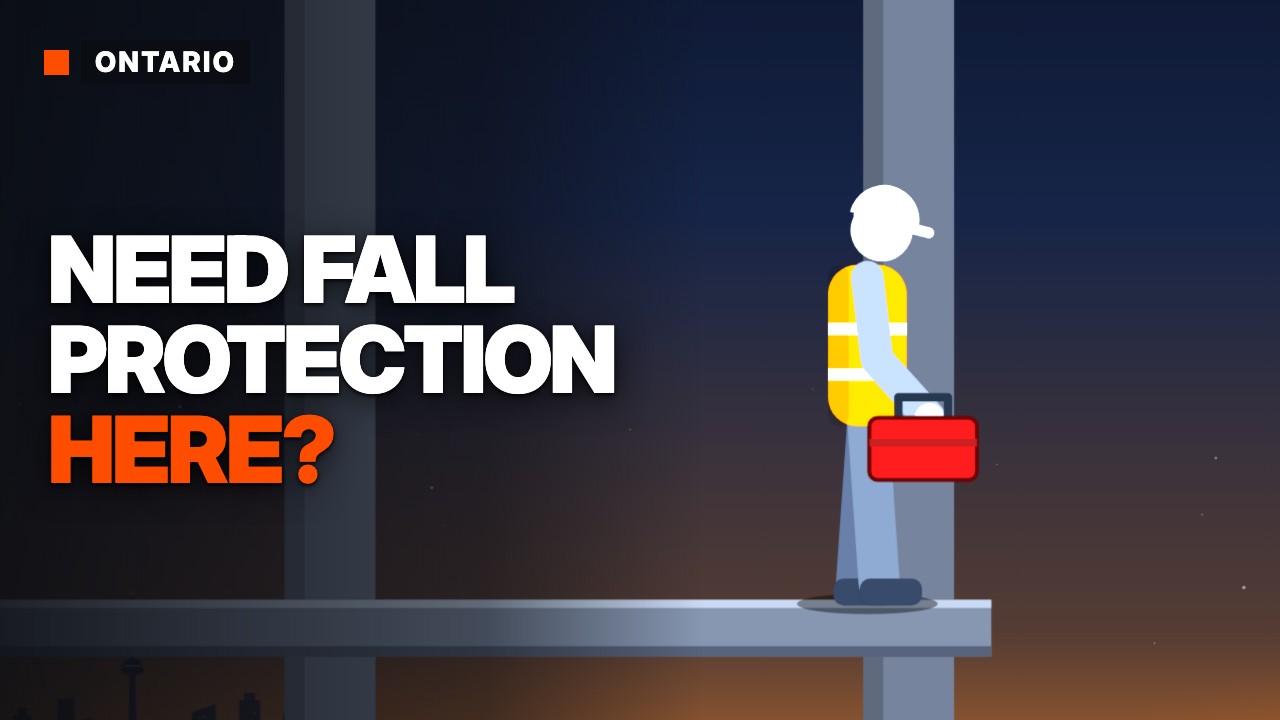
You step onto a second-storey deck with your tools in hand. There's no rail on the open side, just a drop to the slab below. Do you need fall protection here, and which kind?
When You Need It
If you could fall more than 3 metres, you need fall protection. Over 1.2 metres, you need it where your work area is a path for wheelbarrows or similar equipment. At any height, you need it if you could fall into operating machinery, water or another liquid, or through an opening in the work surface. You also need it if you could fall into or onto a hazardous substance or object. Guidance is that this means chemicals or biological substances in a vat or pit, or sharp, protruding objects that could pierce your body, not flat concrete, pavement or garden soil. And make it a habit: when you start a new task, move to a new edge or opening, or conditions change, ask again: do I need fall protection here, and which kind?
Guardrails at 2.4 m
A guardrail must be used if you could fall 2.4 metres or more, where you can reach an edge or open side. That applies to a floor, including a mezzanine or balcony. It also applies to a bridge surface, a roof while formwork is in place, or a scaffold or other work platform, runway or ramp.
The Order of Fall Protection
There's an order to fall protection. Start at the top of the list, and use the first method that's practicable. The order is: a guardrail, then travel restraint, then fall restricting, then fall arrest, then a safety net. Whatever you use has to meet the rules for that system. Why guardrails first? The guidance ranks a physical control like a guardrail ahead of personal protective equipment. You can move around more freely behind it, and nobody has to plan what to do after a fall. So what does practicable mean? Guidance is to weigh all the facts, not just whether a guardrail can be built, and cost doesn't outweigh your safety. For example, if putting up a guardrail would take as long as the job itself, using personal fall protection for the job can be justified. And where a guardrail is required, it isn't optional.
Rebar Walls
If you're installing rebar on a wall of horizontal bars, more than 3.7 metres above the ground or floor, you must be given a scaffold. If a scaffold can't be put up, you use and wear a work belt strong enough to support you. It has a back support pad and a front hook. Never climb that wall carrying bars.
Recap
To recap. Fall protection over 3 metres, or over 1.2 metres on a wheelbarrow path. At any height over operating machinery, liquid, a hazardous substance or object, or an opening. Guardrails at open edges of floors, bridges, platforms and ramps you can reach, where you could fall 2.4 metres or more. If it isn't practicable, the highest method that is. And make it a habit: when the task, the edge or the conditions change, ask again.
Sources
- Ontario Regulation 213/91, Construction Projects
- Ontario Ministry of Labour, Immigration, Training and Skills Development guidance
- Dashpot recommended practice (said as such in the video)
This video is for work in Ontario, Canada. It covers Ontario requirements and good practice, and the narration says which is which. It is not Working at Heights training (the program approved by Ontario's Chief Prevention Officer). Rules differ in other provinces and in the US. General information only, not legal advice. Always follow the regulations, your employer's procedures and the instructions of a competent person on your site. Narration is AI-generated (the Dashpot narrator voice); every script is checked against the sources listed above before it is voiced.
Dashpot checks that every worker on your crew understood the hazards and controls for the day's work. See how it works.