Check your understanding.Spot what's wrong on a job site and say it in your own words. Free, about 5 minutes.
Take the checkChapters
Transcript
Where Guardrails Go
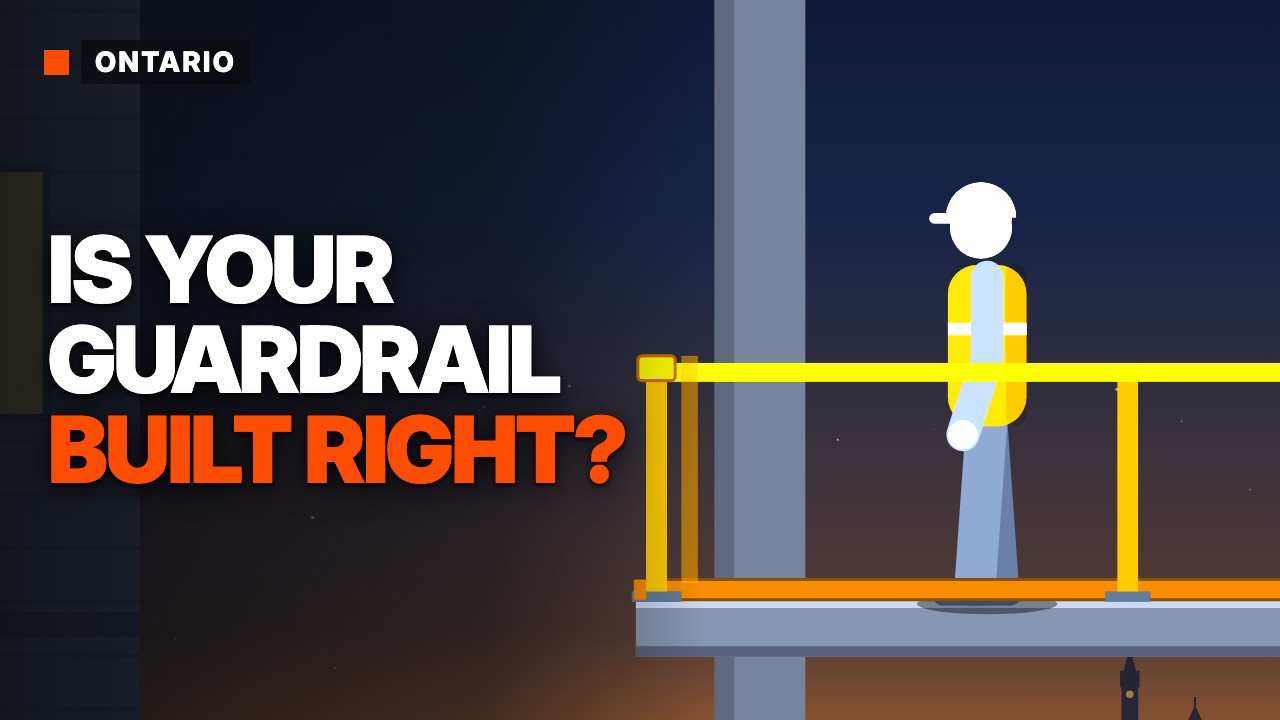
There's a guardrail at every open edge on this floor. Do you know if the one in front of you is built right?
A guardrail must be used if you could fall 2.4 metres or more, where you can reach an edge or open side. That covers floors, including mezzanines and balconies, bridge surfaces, and roofs while formwork is in place. It also covers scaffolds, work platforms, runways, and ramps. So when is an edge out of reach? Picture a balcony off a finished floor. Guidance is that if the door to it is locked with controlled key access, or a physical barrier blocks the doorway, you can't reach the edge, so no guardrail is needed there. A snow fence isn't enough to block it, and a sign doesn't replace a barrier.
The Three Parts
A guardrail system must have three parts: a top rail, a mid rail and a toe board. The top rail sits at least 0.9 metres above the surface, and no more than 1.1 metres. The toe board must reach at least 89 millimetres up from the surface. The mid rail goes halfway between the top rail and the toe board. At the edge of a work surface, the guardrail must sit no more than 300 millimetres from the edge. Working on stilts? The guardrail gets another top rail 76 centimetres above the existing one, or as high above it as the stilts are tall, with a middle rail halfway between the two. And best practice: never stand on a guardrail to get higher.
Wooden Guardrails
A wooden guardrail must be spruce, pine, or fir, construction grade or better. It must have no visible defects that weaken it, and no splinters, protruding nails, or other sharp objects. Posts, top rails, and mid rails must each be at least 38 by 89 millimetres. That's a 2 by 4. Fasten the posts securely to the surface. Space them no more than 2.4 metres apart.
The First Installation
What about the worker putting the guardrail up? Where the 2.4 metre rule applies, the worker doing that first installation needs fall protection too, even if the drop is under 3 metres. The same goes for the first guardrail or cover over an opening.
Recap
To recap. Guardrails where you can reach the open edge and could fall 2.4 metres or more. Top rail 0.9 to 1.1 metres up, a mid rail halfway, and a toe board at least 89 millimetres high, no more than 300 millimetres from the edge. Wooden posts and rails at least 38 by 89 millimetres, posts at most 2.4 metres apart. And the worker putting up the first guardrail or cover needs fall protection too.
Sources
- Ontario Regulation 213/91, Construction Projects
- Ontario Ministry of Labour, Immigration, Training and Skills Development guidance
- IHSA Construction Health and Safety Manual and IHSA guidance
This video is for work in Ontario, Canada. It covers Ontario requirements and good practice, and the narration says which is which. It is not Working at Heights training (the program approved by Ontario's Chief Prevention Officer). Rules differ in other provinces and in the US. General information only, not legal advice. Always follow the regulations, your employer's procedures and the instructions of a competent person on your site. Narration is AI-generated (the Dashpot narrator voice); every script is checked against the sources listed above before it is voiced.
Dashpot checks that every worker on your crew understood the hazards and controls for the day's work. See how it works.