Chapters
Transcript
Intro
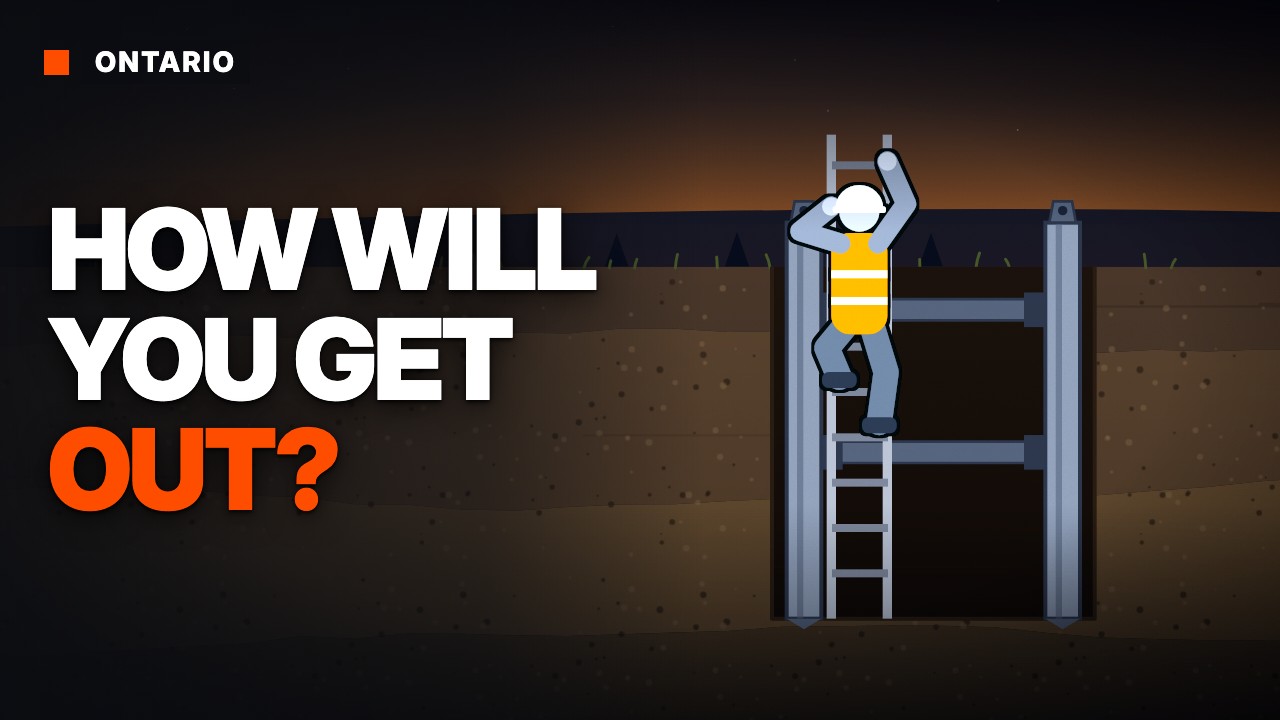
How will you get out of this trench? Ask that before you climb in. The law requires a proper way into and out of a trench at any depth: stairs, a runway, a ramp or a ladder. A movable work platform that meets its own rules can be used instead.
Where the Way Out Goes
Where a trench box or other support system holds the walls, the ladder must be inside the area it protects. Best practice: keep the ladder as close as you can to where people are working, never more than 7.5 m away. Another good habit: check where the ways out are before you go in. Move the ladder forward as the trench advances, and keep its path clear of pipe and materials. A few more good habits: never jump in or out, and never climb the walls or the shoring. And never count on outrunning a collapse.
Ladders, Ramps and Light
A portable ladder used to get in or out must extend at least 900 mm above the landing at the top.
A ramp must be designed, built and maintained to carry every load it is likely to get. It must be at least 460 mm wide and securely fastened. Except some stairwell ramps in buildings of two storeys or less, it must be no steeper than 1 in 3. If it is steeper than 1 in 8, it needs 19 mm x 38 mm cross cleats, securely nailed, evenly spaced no more than 500 mm apart. Best practice: before using a ramp, check it is solid, wide enough, not slippery, and has its edge protection. Stay within its load limit. Don't walk a ramp while a machine is using it; keep people and equipment apart.
The areas where workers are, and the ways in and out of them, must be adequately lit.
Recap
To recap. Stairs, a runway, a ramp or a ladder: a proper way in and out, at any depth. Keep the ladder inside the area the box or shoring protects. A portable ladder for getting in and out extends at least 900 mm above the top landing. Make it a habit to keep the ladder as close to the work as you can, within 7.5 m, and never climb the walls or the shoring.
Sources
- Ontario Regulation 213/91, Construction Projects
- IHSA Construction Health and Safety Manual and IHSA trenching guidance
- Dashpot recommended practice (said as such in the video)
This video is for work in Ontario, Canada. It covers Ontario requirements and good practice, and the narration says which is which. Rules differ in other provinces and in the US. General information only, not legal advice. Always follow the regulations, your employer's procedures and the instructions of a competent person on your site. Narration is AI-generated (the Dashpot narrator voice); every script is checked against the sources listed above before it is voiced.
Dashpot checks that every worker on your crew understood the hazards and controls for the day's work. See how it works.