Chapters
Transcript
Intro
Before anyone steps into a trench, ask one question: what protection does this trench need? The answer depends on how deep it is, and on the soil you are digging in.
When Walls Must Be Protected
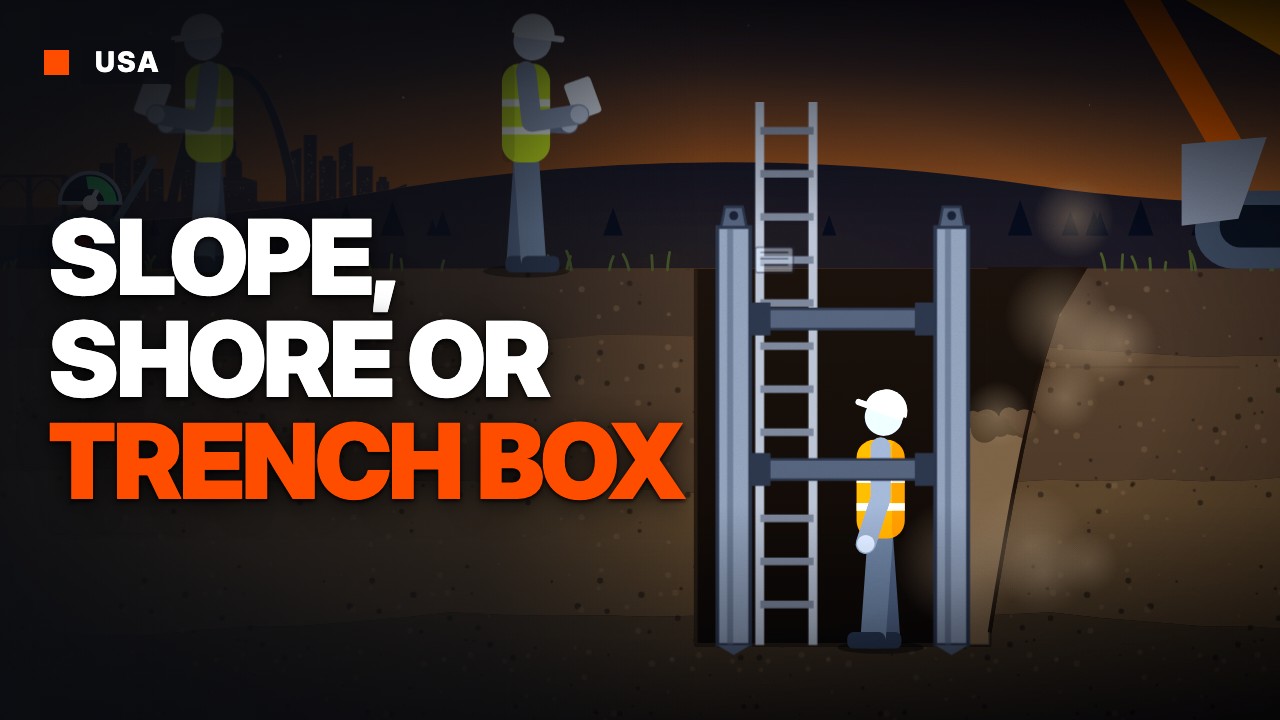
If anyone works in a trench 5 feet deep or more, the law requires a protective system to protect them from a cave-in, unless it's dug entirely in stable rock. Under 5 feet, it can be left out only if a competent person examines the trench and finds no sign of a possible cave-in. There are three main ways to protect a trench: slope or bench the walls, shore them, or use a trench box. Rock counts as stable only if it stays intact with vertical sides, or is secured with rock bolts or another system a registered professional engineer designs.
Sloping
Sloping: in a trench 20 feet deep or less, the soil type sets the steepest slope allowed. In Type A, the strongest soil, the walls can be no steeper than 3/4 horizontal to 1 vertical, or 1/2 to 1 in a trench no deeper than 12 feet that is open for 24 hours or less. In Type B, no steeper than 1 to 1. In Type C, the weakest, no steeper than 1 1/2 to 1. Walls can be benched within the same slope: in Type A, the bottom bench is no more than 4 feet high, and any bench above it no more than 5 feet. In Type B, benching is allowed only in cohesive soil, with each bench no more than 4 feet high; the standard layouts give no benching for Type C. In Type A, the bottom 3 1/2 feet can stay vertical in a trench up to 8 feet deep. These limits are for the best conditions: if the walls crack, slump or bulge, cut the slope back at least another 1/2 to 1, and with loads near the edge, a competent person decides how much flatter it must be.
Shoring
Shoring: a timber, hydraulic or mechanical structure that supports the trench walls to prevent a cave-in. Timber shoring is sized from tables by soil type, depth, width and brace spacing, within the tables' limits. Hydraulic and pneumatic shoring that isn't timber must be designed under the rules for protective systems. It's wise to pick one with a safeguard that keeps it holding if pressure is lost, and to check its pressure at each inspection.
Trench Boxes
A trench box, also called a shield, can withstand the forces of a cave-in, and so protects the workers inside it. It must be installed so it can't move dangerously if a sudden sideways load hits it. It must never be loaded beyond what it was designed for.
When an Engineer Must Sign Off
Some protection needs an engineer. A trench more than 20 feet deep must have its protective system designed by a registered professional engineer, unless it's a manufacturer's shoring or box rated for that depth and used the way the manufacturer says. A box or shoring built from a manufacturer's data must follow all of the manufacturer's specifications, recommendations and limits; any change needs the manufacturer's specific written approval. These, and any approval to change them, must be kept in writing at the jobsite while it's being built.
Recap
To recap. Anyone working in a trench 5 feet deep or more must be protected from a cave-in, unless it's dug entirely in stable rock. Protect them by sloping or benching the walls, shoring them, or using a trench box. Slope the walls no steeper than the soil type allows: 3/4 to 1 in Type A, 1 to 1 in Type B, and 1 1/2 to 1 in Type C. Cut them flatter if the walls show distress or carry loads at the edge. Deeper than 20 feet, a registered professional engineer designs the protective system, unless it's a manufacturer's shoring or box rated for that depth and used as the manufacturer says. And for a box or shoring built from a manufacturer's data, any change needs the manufacturer's written approval.
Sources
- US OSHA excavation standard (29 CFR 1926 Subpart P)
- OSHA letter of interpretation on engineer approval of manufactured trench protection deeper than 20 feet
- Dashpot recommended practice (said as such in the video)
This video is for work in the United States. It covers federal OSHA requirements and good practice, and the narration says which is which. States with their own OSHA-approved plans, and each state's 811 law, can set different or stricter rules. Rules also differ in Canada. General information only, not legal advice. Always follow federal and state regulations, your employer's procedures and the instructions of a competent person on your site. Narration is AI-generated (the Dashpot narrator voice); every script is checked against the sources listed above before it is voiced.
Dashpot checks that every worker on your crew understood the hazards and controls for the day's work. See how it works.