Chapters
Transcript
Before You Uncover It
You've found the line. Now you're going to uncover it. Before digging, Ontario law requires a service that may be a hazard to be shut off and disconnected. If it can't be, the law requires that its owner be asked to supervise the uncovering. When a job needs a service interrupted, it's wise to plan it with the service's owner and the project owner. And never operate a utility's valves, switches or other equipment yourself.
Exposed Lines
Ontario law requires gas, electrical and other service lines in an excavation to be supported so they don't fail or break. Keep in mind that an exposed line can shift, separate or be damaged once the soil stops holding it. So it's wise to support and protect it the way its owner asks. A good habit: get support instructions from the utility. Keep temporary support until the backfill under the line has cured or been compacted enough to hold it again. Make a habit of never climbing on an exposed line, striking it or trying to move it. If it needs moving, call the utility to arrange it.
If You Hit One
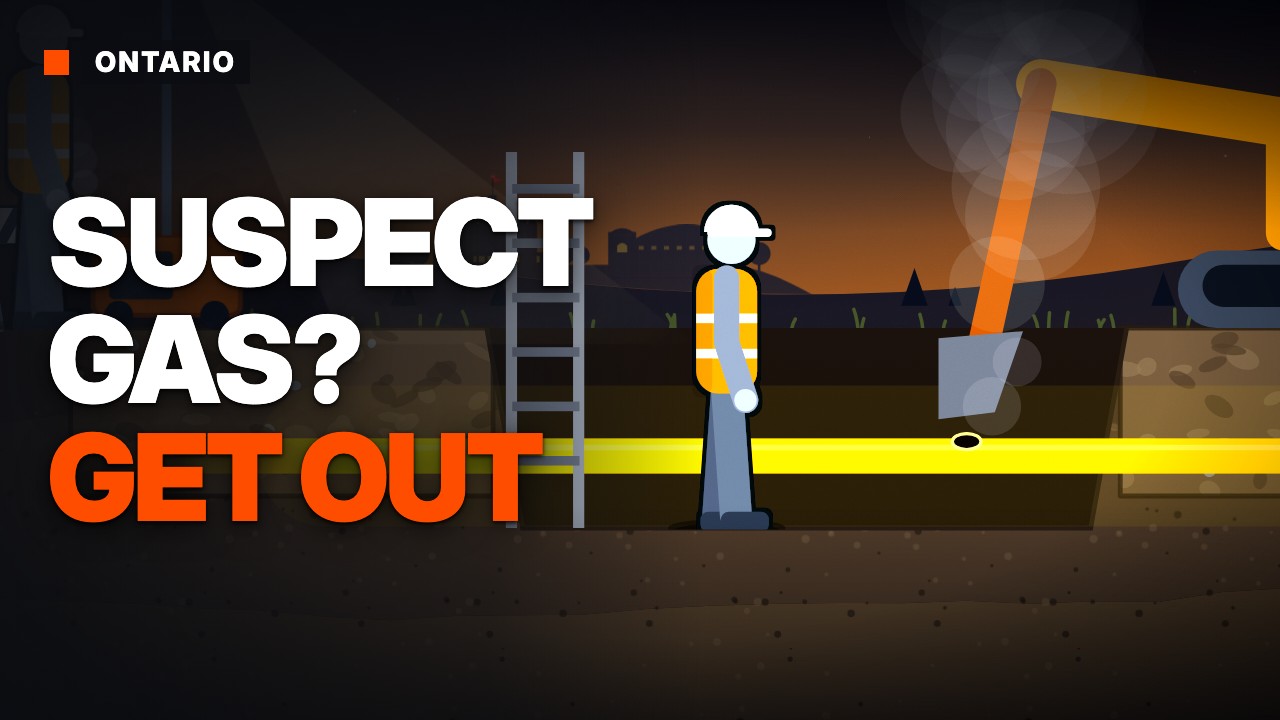
If you suspect a gas leak, the safe move is to get out of the trench at once, and tell people nearby to leave. Shut off vehicles and equipment, put out ignition sources, barricade, and keep everyone away. Call 911 and the gas utility right away. And never try to control escaping gas, or repair a damaged line yourself. For any strike that releases something dangerous or puts people at risk, notify the authorities and the line owner right away, protect people and property, and stay to brief responders. If a steam or high-pressure water line is hit, the safe habit is to stay clear of the jet, the vapour, flooding and undermined ground, and never go near the leak to find out what it is. If a sewer gets hit, it's recommended to get out of the trench, because sewage gives off hazardous gases.
Minor Damage
Not every hit is an emergency. If a line is damaged in any way, even a scratch in its coating, the recommended step is to leave it exposed. Barricade the area and contact the utility right away. A good habit: keep every utility's contact name and number at the site, along with the Ontario Dig Authority's. Write them on the locate sheet too.
Recap
To recap. Before digging, a hazardous service is shut off and disconnected; if it can't be, its owner is asked to supervise. Exposed lines are supported so they don't fail. Good habits: never climb on, strike or move a line; call the utility to move it. If you suspect gas, get out of the trench at once, and tell people nearby to leave. Never try to repair a damaged line. And for any damage, even a scratch in the coating: leave it exposed, barricade, and call the utility right away.
Sources
- Ontario Regulation 213/91, Construction Projects
- ESA/TSSA Guideline for Excavating in the Vicinity of Utility Lines
- Canadian Common Ground Alliance Damage Prevention Best Practices
- IHSA Construction Health and Safety Manual and IHSA trenching guidance
- Dashpot recommended practice (said as such in the video)
This video is for work in Ontario, Canada. It covers Ontario requirements and good practice, and the narration says which is which. Rules differ in other provinces and in the US. General information only, not legal advice. Always follow the regulations, your employer's procedures and the instructions of a competent person on your site. Narration is AI-generated (the Dashpot narrator voice); every script is checked against the sources listed above before it is voiced.
Dashpot checks that every worker on your crew understood the hazards and controls for the day's work. See how it works.