Chapters
Transcript
The Plan
If someone is hurt or buried in this trench, what is the plan? The time to answer that is before work starts. Written emergency procedures are required for the project. They must be posted where they can easily be seen, and they must be followed. Make it a habit to practise the plan with your crew before it is needed.
People and Phones
By law, no one may work in a trench unless another worker is working above ground, close to the trench or its access. The constructor must make sure every worker has ready access to a phone, two-way radio or other two-way communication in an emergency. Before you go in, it's wise to agree with the worker on top how you'll signal each other. Agree how often you'll check in. If you lose sight of each other or can't communicate, the safe habit is to stop work until contact is back.
If It Happens
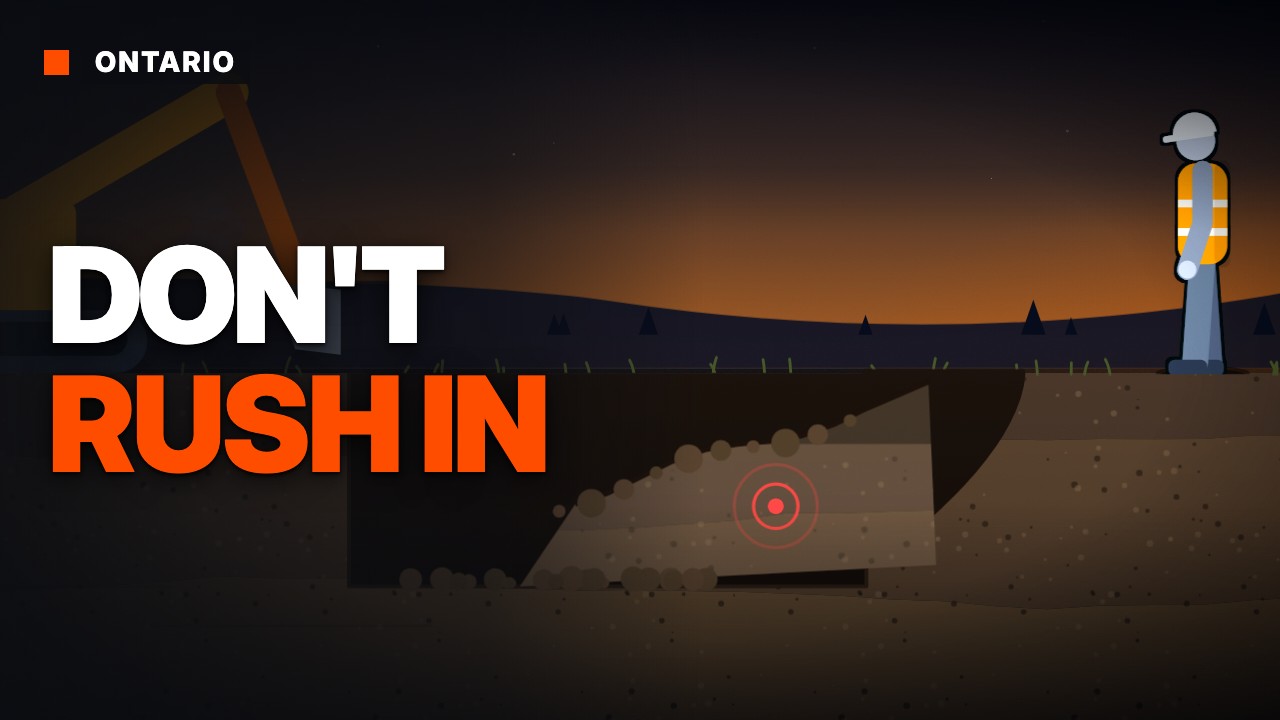
Best practice if someone is caught or buried: don't rush in. It is natural to want to rescue them. But rescuers can be killed by a further cave-in, or by other hazards. Instead, call 911, ask for trench rescue, and give the exact location. Have someone guide the responders in. Keep people and machines back from the edge. Shut down nearby equipment to stop vibration, and never dig with a machine near the buried worker. If a worker collapses where the air may be bad, the safe habit is not to go in, even holding your breath. Raise the alarm and keep others out.
Recap
To recap. Written emergency procedures are required, posted where they're easily seen, and followed. A good habit: practise them with the crew. Never work in a trench without another worker working above ground nearby. If someone is buried, the recommended steps are to call 911 for trench rescue, give the exact location, and not rush in.
Sources
- Ontario Regulation 213/91, Construction Projects
- IHSA Construction Health and Safety Manual and IHSA trenching guidance
- Dashpot recommended practice (said as such in the video)
This video is for work in Ontario, Canada. It covers Ontario requirements and good practice, and the narration says which is which. Rules differ in other provinces and in the US. General information only, not legal advice. Always follow the regulations, your employer's procedures and the instructions of a competent person on your site. Narration is AI-generated (the Dashpot narrator voice); every script is checked against the sources listed above before it is voiced.
Dashpot checks that every worker on your crew understood the hazards and controls for the day's work. See how it works.