Chapters
Transcript
The Edge
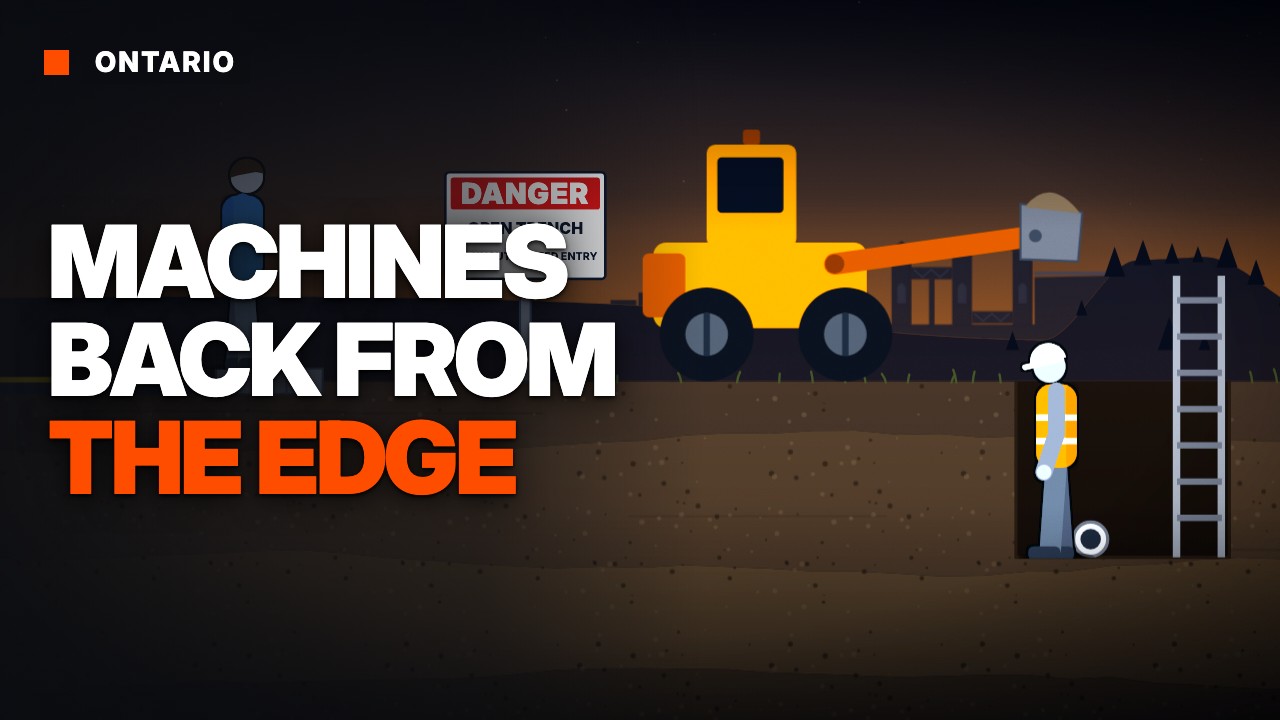
What around this trench can fall or drive into it? Start with the edge. Keep the first metre along the edge of the trench level, and clear of spoil, equipment and debris. Where piles could affect a wall, the wall must be kept stable. A good habit: the deeper the trench, the farther back the spoil goes. Frozen ground doesn't mean you can put a heavier load near the edge. Tell your supervisor before heavy loads or equipment come closer to the edge, so the protection can be rechecked.
Falls and Falling Material
The walls must be stripped of loose rock or other material that could slide, roll or fall onto a worker. Where a wall isn't sloped as the regulation allows, and someone could fall more than 2.4 metres, the law requires a barrier at least 1.1 metres high. It goes at the top of that wall. An opening someone could fall through must have a guardrail, or a cover over the whole opening that's fastened, marked and strong enough. Best practice: stay back from the edge, and cross only on a secured walkway with guardrails. Never jump across, or walk on pipe, shores, spreaders, box tops or loose planks. It's also wise not to work on a sloped or benched face above other workers unless they're protected.
Machines Near the Walls
No machine may be run or placed where it would affect a wall's stability, typically at least 1 metre back from the edge. If an operator can't see the path, or someone could be endangered, a signaller must help. Best practice: aim work lights away from operators, and stop work when you can't see clearly.
Loads and Reversing
A backhoe or similar machine must never pass itself or its load over a worker. The job must be planned so machines reverse as little as possible. Before backfill, make a habit of accounting for everyone, and stay out of the dumping zone. Confirm with the operator, by a signal you agreed on, before each load goes in.
Keeping the Public Out
DANGER signs must warn of the hazard, with the word DANGER at least 150 mm high, saying unauthorized entry is forbidden. Only authorized workers may enter a signed area. If the work may endanger the public, a sturdy fence at least 1.8 m high must separate the two. Before you leave for the night or weekend, make a habit of fencing, covering or barricading the trench, and putting up lights and signs. Pull out any ladder the public could reach, and have the trench checked before anyone goes back in.
Recap
To recap. Keep the first metre at the edge clear. Strip loose rock off the walls. Put up barriers where a fall would be more than 2.4 metres. Never swing a backhoe or its load over a worker. Use a signaller when the operator can't see the path, or someone could be endangered. And where the work could endanger the public, put a sturdy fence at least 1.8 metres high between them and the work.
Sources
- Ontario Regulation 213/91, Construction Projects
- IHSA Construction Health and Safety Manual and IHSA trenching guidance
- Dashpot recommended practice (said as such in the video)
This video is for work in Ontario, Canada. It covers Ontario requirements and good practice, and the narration says which is which. Rules differ in other provinces and in the US. General information only, not legal advice. Always follow the regulations, your employer's procedures and the instructions of a competent person on your site. Narration is AI-generated (the Dashpot narrator voice); every script is checked against the sources listed above before it is voiced.
Dashpot checks that every worker on your crew understood the hazards and controls for the day's work. See how it works.