Chapters
Transcript
The Edge
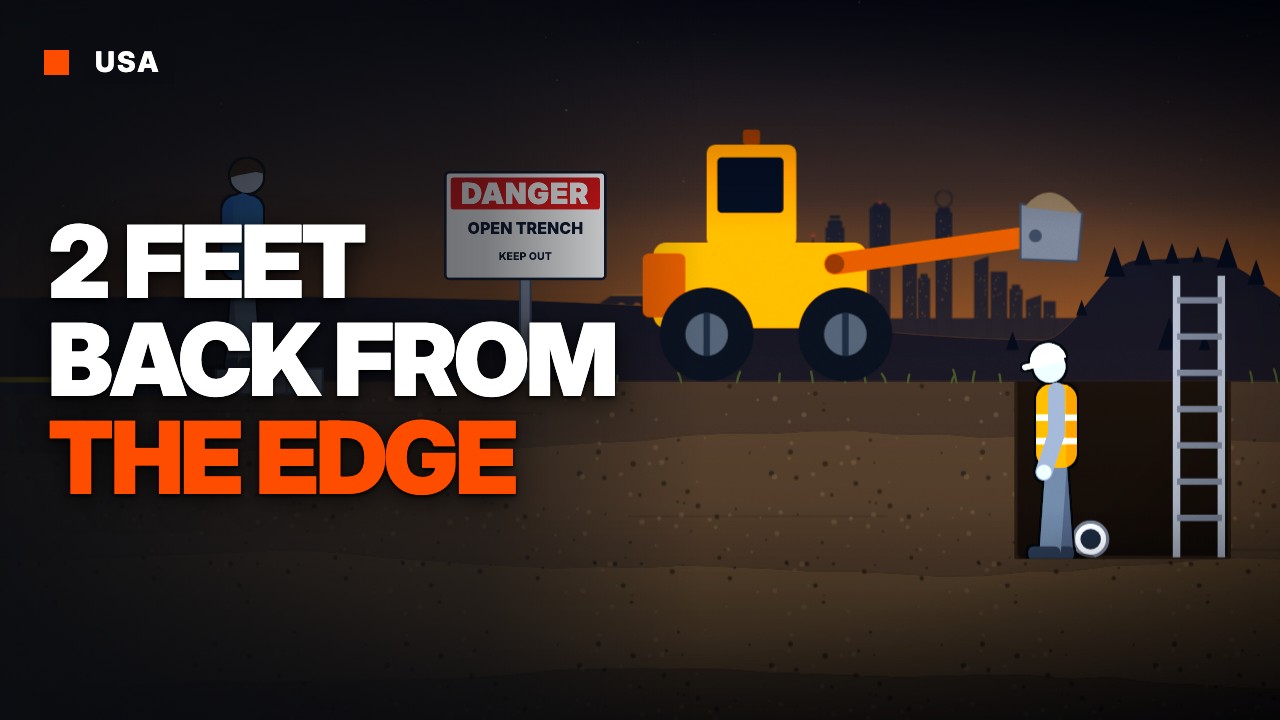
What around this trench can fall or drive into it? Start with the edge. Keep spoil, equipment and materials at least 2 feet back from the edge, or hold them back so they can't fall or roll in. A good habit: the deeper the trench, the farther back the spoil goes. Frozen ground doesn't mean you can put a heavier load near the edge. Tell your supervisor before heavy loads or equipment come closer to the edge, so the protection can be rechecked.
Falls and Falling Material
Loose rock or soil that could fall or roll off a wall must be scaled off, or stopped by barricades on the face. Where a trench 6 feet deep or more is hard to see, such as behind plants, the law requires guardrails, fences or barricades. They keep workers at the edge from falling in. A cover over a hole must be secured, color-coded or marked HOLE or COVER, and hold twice its heaviest expected load. Where people or equipment cross a trench, the law requires a walkway, with guardrails where the drop is 6 feet or more. Best practice: stay back from the edge, and make sure a walkway is secured before you step onto it. Never jump across, or walk on pipe, shores, spreaders, box tops or loose planks. No one may work on a sloped or benched face above other workers unless those below are protected from falling material.
Machines Near the Walls
The protection must hold every load it could reasonably get, such as a machine near the edge. When a machine works near the edge and the operator can't clearly see it, a warning system must be used, such as barricades, hand signals or stop logs. Best practice: aim work lights away from operators, and stop work when you can't see clearly.
Loads and Reversing
No one may be under a load handled by a backhoe or any other lifting or digging machine. Earthmoving equipment that can't see behind it may reverse only with a backup alarm heard over the noise, or when a worker signals it's safe. Before backfill, make a habit of accounting for everyone, and stay out of the dumping zone. Check with the operator, by a signal you agreed on, before each load goes in.
Keeping the Public Out
DANGER signs are for immediate hazards only, and must be visible whenever work is going on. Where the work could endanger people on a sidewalk or road, it's wise to put a sturdy fence at least 6 feet high between them and the work. Before you leave for the night or weekend, make a habit of fencing, covering or barricading the trench, and putting up lights and signs. Pull out any ladder the public could reach. Before work starts again, a competent person must inspect the trench.
Recap
To recap. Keep spoil and equipment at least 2 feet back from the edge, or held back. Scale loose rock or soil off the walls, or barricade it. Put up guardrails, fences or barricades where a trench 6 feet or deeper is hard to see. Never stand under a load from a backhoe or other digging or lifting machine. Use a warning system, like hand signals or stop logs, when an operator can't clearly see the edge. And where the work could endanger the public, it's wise to put up a sturdy fence at least 6 feet high.
Sources
- US OSHA excavation standard (29 CFR 1926 Subpart P)
- US OSHA construction standards: fall protection
- US OSHA construction standards: signs and barricades
- US OSHA construction standards: earthmoving equipment
- Dashpot recommended practice (said as such in the video)
This video is for work in the United States. It covers federal OSHA requirements and good practice, and the narration says which is which. States with their own OSHA-approved plans, and each state's 811 law, can set different or stricter rules. Rules also differ in Canada. General information only, not legal advice. Always follow federal and state regulations, your employer's procedures and the instructions of a competent person on your site. Narration is AI-generated (the Dashpot narrator voice); every script is checked against the sources listed above before it is voiced.
Dashpot checks that every worker on your crew understood the hazards and controls for the day's work. See how it works.